
Council
Elisabete Martins
Winner 2026 - Martin Beckmann Annual Award for the best paper published in Papers in Regional Science in 2025
The winner of the Martin Beckmann Award for the best paper published in 2025 in PiRS is "Adolescence socioeconomic segregation and high-skilled jobs in adulthood", by Sofia Wixe, Charlotta Mellander and José Lobo.
Congratulations!
For more information, visit https://www.regionalscience.org/index.php/awards/martin-beckmann-rsai-annual-award.html
RSAI NNT2026 | Last days to apply: ERSA Summer School 2026
|
||||||||||||||||||||||||||||
|



Call for Papers | PRSCO 2026 | 29th Pacific Conference of the RSAI, 1-3 December 2026, RMIT University, Melbourne, Australia
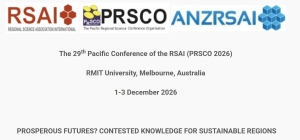
The 29th Pacific Conference of the RSAI (PRSCO 2026) RMIT UNIVERSITY, MELBOURNE, AUSTRALIA 1-3 DECEMBER 2026
PROSPEROUS FUTURES? CONTESTED KNOWLEDGE FOR SUSTAINABLE REGIONS
FIRST CALL FOR PAPERS
Australia New Zealand Regional Science Association International (ANZRSAI) jointly with PRSCO is organising 29th PRSCO Conference at RMIT University, Melbourne. PRSCO welcomes proposals for contributed papers, for themed panels, or for special sessions, on any topic related to regions. This year’s conference is hosted by RMIT University, Melbourne. To register, and for more information on the conference, visit the ANZRSAI website at: https://www.anzrsai.org/conference/conference-2026/
The first call of papers can be downloaded (https://www.anzrsai.org/assets/Uploads/PRSCO-2026-First-Call-for-Papers-V1.pdf).
The deadline for abstract submission is 30 April 2026.
-----
Call for Submissions
PRSCO Award for Best Paper by a Young Regional Scientist
The Pacific Regional Science Conference Organization (PRSCO) offers a Best Paper Award annually. The Award is aimed at encouraging young regional scientists within the Asia-Pacific region to participate in research within the PRSCO community and to achieve research excellence. PRSCO now invites submissions for the 2026 Award.
The Award will be made for the best submission to the PRSCO Best Paper competition by a young regional scientist, under the age of 35 (on December 31, 2026), who is from a PRSCO-relevant part of the world.
The Award rules can be found on the PRSCO web site.
Papers submitted for the Best Paper Award should be presented to the 28th Pacific Conference of the RSAI in 2026 at Melbourne on December 1-3, 2026.
The LOC of the PRSCO 2026 will waive the registration fee for the Prize winner.
Eligible authors who wish to submit a paper to the PRSCO Best Paper competition should email a pdf copy of their paper to the PRSCO Executive Secretary, Soushi Suzuki, This email address is being protected from spambots. You need JavaScript enabled to view it., by no later than July 31, 2026
Papers will be assessed by a PRSCO Best Paper Selection Committee and the author of the winning paper is expected to be notified by October 31, 2026. The decision of the Selection Committee will be final.
Submissions should include a cover page with the paper’s title, the author’s full name, affiliation, and contact details. Award applicants should either: state that the paper is single-authored; or provide the name of the co-author(s), together with evidence that the applicant is the lead author and has contributed over 70 per cent of the paper’s content. The applicant should also affirm that they meet the Award’s age criterion.
-----------
PRSCO website URL was changed to
Spanish Section | Call for Abstacts: VII Seminar for New Academic Researchers (SNAR) 2026 – University of Alcalá – 24-25 September 2026
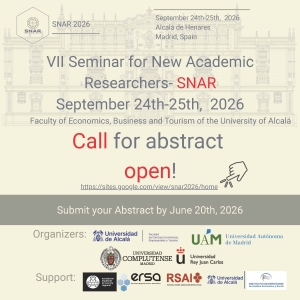
VII SEMINAR FOR NEW ACADEMIC RESEARCHERS – 24th – 25th September 2026 – Faculty of Economics, Business and Tourism of the University of Alcalá
The Faculty of Economics, Business and Tourism of the University of Alcalá, in Madrid, is pleased to host the VII Seminar for New Academic Researchers (SNAR) 2026.
Following the aims and scope of the previous successful editions, the SNAR seeks to gather a group of researchers, academics, and students (PhD candidates or graduates) to share previous, current, and potential future works among all participants rather than presenting a specific research paper, with the main purpose of guiding new researchers in developing their long-term careers.
Thus, we especially invite you to present a line of research (past, present, or future), or a project in which you are involved (or that you are interested in) rather than just a specific article. This year, the seminar will be completed with some training courses for early career researchers.
We encourage contributions on topics related (but not limited) to the diverse fields involved in regional science and input-output analysis: economics, econometrics, urban planning, geography, tourism, inequality, health and welfare, impact evaluation, structural analysis, environmental economics, labour market, etc.
The format of the Seminar will be hybrid: all sessions (i.e., practical courses, panel sessions and lectures) will be available in a virtual platform. Therefore, registration and attendance to the SNAR may be onsite or online, indistinctly.
All the valuable comments and suggestions shared during the meeting will also contribute to building a network of researchers interested in regional economic development and Economic geography.
Please, confirm your willingness to participate in this Seminar by sending your abstract to This email address is being protected from spambots. You need JavaScript enabled to view it., including your name(s), affiliation(s), type of assistance (online or onsite), main topic and 3-5 keywords.
The Seminar will be held on September 24th-25th, 2026, in Alcalá de Henares, Madrid (Spain), at the Faculty of Economics, Business and Tourism of the University of Alcalá. Come to check it out and spread the word! Looking forward to meeting you all in Madrid.
Deadlines:
Submission of abstracts: June 20th, 2026.
Notification of acceptance: July 5th, 2026
More information at: https://sites.google.com/view/snar2026/home
New Issue: Regional Science Policy & Practice | Volume 18, Issue 4, April 2026
|
|
Articles
|
|
|
|
|
|
Book Reviews
|
|
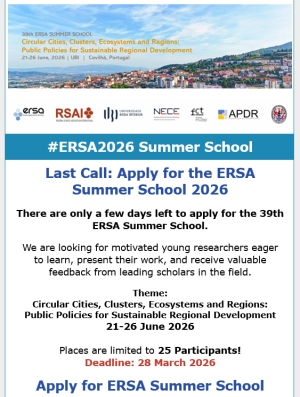
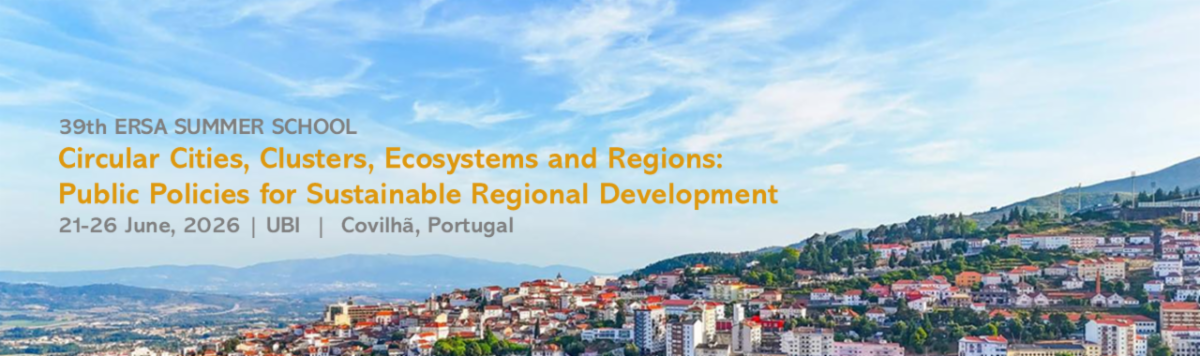
RSAI NNT2026 | Apply for ERSA Summer School in Covilhã, Portugal, 21–26 June 2026
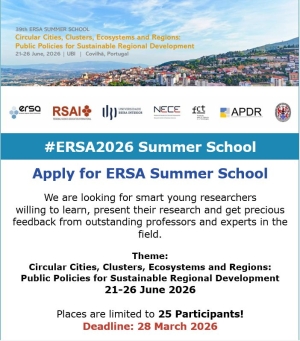
Apply to the 39th ERSA Summer School 2026
The European Regional Science Association (ERSA) is pleased to announce the 39th ERSA Summer School, organised in collaboration with the University of Beira Interior (UBI), NECE – Research Centre for Business Sciences, and APDR.
 Covilhã, Portugal
 21–26 June 2026
 Deadline to apply: 28 March 2026
 Learn more and apply here: https://ersa.eventsair.com/2026-ersa-summer-school
RSAI NNT2026 | Apply for ERSA Summer School in Covilhã, Portugal, 21–26 June 2026
Apply to the 39th ERSA Summer School 2026
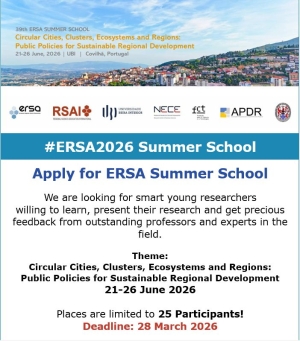
The European Regional Science Association (ERSA) is pleased to announce the 39th ERSA Summer School, organised in collaboration with the University of Beira Interior (UBI), NECE – Research Centre for Business Sciences, and APDR.
Covilhã, Portugal 21–26 June 2026 Deadline to apply: 28 March 2026 Learn more and apply here: https://ersa.eventsair.com/2026-ersa-summer-school
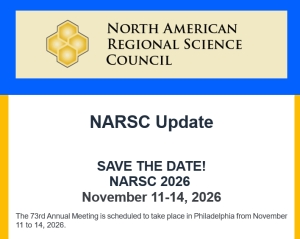
Save the Date: NARSC 2026 in Philadelphia Nov 11-14, 2026.
|

Call for Papers | RSPP Special Issue: Understanding Spatial Disparities in the Global South: Evidence and Policy Implications. Submissions extended deadline: July 31st 2026

Regional Science Policy & Practice (RSPP)
Call for Papers Special Issue: Understanding Spatial Disparities in the Global South: Evidence and Policy Implications
Guest Editor: Carolina Guevara Rosero, Departamento de Ciencias Administrativas, Escuela Politécnica Nacional - This email address is being protected from spambots. You need JavaScript enabled to view it.
Developing countries, currently denominated as Global South, are characterized by spatial disparities combined with rapid urbanization, demographic change, and shifting economic structures. These disparities raise urgent questions for policy, as they affect opportunities for growth, the provision of public goods, and the achievement of inclusive and sustainable development. Addressing them requires both robust evidence and a clear understanding of how policy interventions can mitigate inequalities across regions.
This Special Issue invites contributions that advance knowledge on the drivers, consequences, and policy responses to spatial disparities in the Global South. We particularly welcome research that offers actionable insights for policymakers, practitioners, and international organizations, as well as comparative analyses that highlight lessons transferable across contexts.
We welcome high-quality contributions that explore, but are not limited to, the following themes:
- Policy frameworks and strategies to reduce regional inequalities.
- Evaluation of place-based vs. people-based policies in the Global South.
- The effectiveness of infrastructure, transport, and connectivity policies in reducing disparities.
- Agricultural and rural development policies and their spatial impacts.
- Urbanization, housing, and spatial planning policies addressing segregation and inequality.
- Health, education, quality of life and social policies with a territorial perspective.
- Migration, labor mobility, crime, spatial segregation and their implications for regional policy.
- Governance, decentralization, and institutional arrangements for territorial development.
- Innovative tools and methodologies for policy evaluation in regional and urban contexts.
- Lessons from comparative policy experiences across countries in the Global South.
We encourage both theoretical and empirical studies, as well as interdisciplinary approaches that combine insights from economics, geography, sociology, political science, and development studies.
All manuscripts will be submitted via the Regional Science Policy & Practice online submission system (https://www.editorialmanager.com/rspp/). Papers should have between 6000 and 8000 words. Authors should indicate in the cover letter that the paper is submitted for consideration for publication in this special issue “Understanding Spatial Disparities in the Global South: Evidence and Policy Implications”, otherwise, your submission will be handled as a regular manuscript. Regional Science Policy & Practice is a gold open access journal. This means that articles accepted for publication will be subject to the payment of an Article Publishing Charge (APC). Standard fees are described in detail on the journal home page.
Submissions extended deadline: July 31st 2026
RSAI NNT2026 | International Conference on Sustainable Regional Development, May 04-06, 2026, Dushanbe, Tajikistan
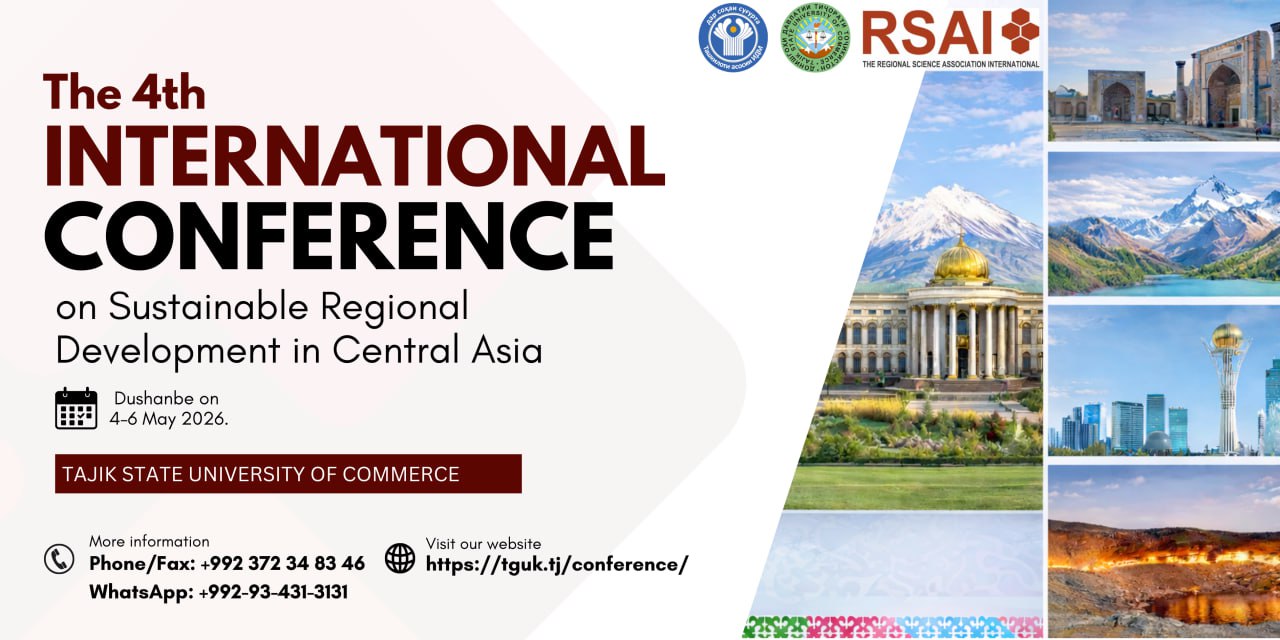
International Conference on Sustainable Regional Development
May 04 – 06, 2026
Dushanbe, Tajikistan
Key dates:
We are pleased to invite you to participate in the International Conference on Sustainable Regional Development, taking place in Dushanbe, Tajikistan. This conference brings together scholars, researchers, and practitioners from around the world to discuss contemporary challenges and innovative solutions in regional development.
The conference welcomes contributions addressing theoretical and empirical aspects of sustainable regional development, including policy analysis, urban planning, economic growth, innovation, and social inclusion.
The conference was organized with the support of the Nurturing Talent Program of the Regional Science Association International (RSAI). We gratefully acknowledge RSAI for promoting the development of regional science and supporting initiatives that foster academic collaboration, capacity building, and the engagement of young researchers in Central Asia.
More info at: https://tguk.tj/conference/index.html
About Us
The Regional Science Association International (RSAI), founded in 1954, is an international community of scholars interested in the regional impacts of national or global processes of economic and social change.