
Council
Elisabete Martins
RSPP Best Reviewer Award
Regional Science, Policy & Practice Best Reviewer Award
(All reviewers of in Regional Science Policy and Practice in 2026 will be considered for the award)
Regional Science, Policy & Practice values the crucial role placed by our colleagues who kindly agree to work for free for the benefit of the journal; help improving the quality of the papers published; and withstand the pressure we all feel, both as authors as well as of editors, triggered by the growing number of journals, journal articles, and, consequently, of the requests sent and received to review papers.
Regional Science, Policy & Practice values the crucial role placed by our colleagues who kindly agree to work for free for the benefit of the journal; help improving the quality of the papers published; and withstand the pressure we all feel, both as authors as well as of editors, triggered by the growing number of journals, journal articles, and, consequently, of the requests sent and received to review papers.
The best reviewer for each calendar year will be chosen as follows.
Each February, the Editors of the journal nominate a maximum of two reviewers who contributed to the improvement of papers they handled. They then gather within Apr. 1 to discuss their proposals, based on the following criteria:
- Contribution to the paper's improvement;
- Number and quality of reviews provided in the calendar year;
- Capacity to meet the review deadlines;
- Use of a constructive and inclusive language in the reviewer's reports submitted.
The editors submit the name of the winner, and a one paragraph motivation for their choice, within mid April, to the RSAI's Executive Director, who then informs the RSAI Council members.
The winner will be presented a certificate at a major RSAI event in the same calendar year (ERSA, NARSC, LARSA, PRSCO, or RSAI World Congress) at the choice of the reviewer.
They will also be offered by the editors a waiver for the APC of an article submitted by the winner in the subsequent calendar year, should the paper be eventually accepted, and irrespective of the actual date of acceptance.
ERSA Monthly E-news - August 2026
|
|||||||||||||||||||||||||||||||||||||||||||||||||||||||||||||||||||||||||||||||||||||||||||||||||||||||||||||||||||||||||||||||||||||||||||||||||||||||||||||||||||||||||||||||||||||||||||||||||||||||||||||||||||||||||||||||
|













Call for Applications for RSAI Councilors-at-large
Dear RSAI members,
It is time to elect three "Councilors-at-large" to be part of the RSAI Council for the period 2027-2029.
The RSAI and its internal organization are not very well known. Please take 2 minutes of your time to read how it works! (https://regionalscience.org/index.php/about-us.html)
The RSAI Council comprises the RSAI President, the RSAI Executive Director, 3 representatives from each supranational (ERSA, LARSA, PRSCO, and NARSC), and 5 Councilors-at-large.
While 3 members are elected from each supranational to keep geographical balance within RSAI, the 5 "councilors at large" will be elected by the members of the RSAI Council among the self-nominated applicants, who will simply need to be an RSAI member in good standing.
The positions on the RSAI Council held by Prof. Camilla Lenzi, Prof. André Chagas and Prof. Katarzyna Kopczewska will expire at the end of 2026.
If you are interested in being a councilor-at-large, please send a letter of interest including your professional CV and a photo to the RSAI Secretariat (This email address is being protected from spambots. You need JavaScript enabled to view it.) before September 30th 2026.
The election of a councilor-at-large for the period 2027-2029 will take place electronically by RSAI members during the month of October 2026.
New data resource for Papers in Regional Science!

REMINDER | Deadline for the 2026 RSAI Best Doctoral Dissertation Award is approaching (August 31, 2026)

Dear colleagues,
I would like to send a friendly reminder that the deadline for the 2026 RSAI Best Doctoral Dissertation Award is approaching (August 31, 2026).
I would greatly appreciate it if you could share this announcement with recent PhD graduates, advisors, colleagues, and relevant networks who may have eligible candidates.
The Regional Science Association International (RSAI) invites submissions for the annual competition for the Best Doctoral Dissertation in Regional Science. Regional science is an interdisciplinary field concerned with theory, method, and application of regional, urban and rural, geographic, and spatial investigations and analyses.
The winner will be selected by the Selection Committee and will receive a cash award of €750. The award will be announced at the North American Meetings of the RSAI, where participants in the competition are strongly encouraged to be present. The Selection Committee reserves the right not to make an award, and its decisions are final.
Eligibility
- A dissertation completed in any PhD program in any country
- A dissertation written in English
- A dissertation successfully defended, with an official graduation date between July 1, 2025 and June 30, 2026
- A dissertation addressing one or more general regional science topics. The Selection Committee reserves the right to determine whether a dissertation is relevant to the field of regional science.
Application materials (PDF or MS Word format)
- A two-page curriculum vitae
- A letter of support and nomination from the major professor (dissertation committee chairperson or supervisor), on official letterhead and with signature. The letter should clearly explain the dissertation’s originality and contributions to the field of regional science.
- The dissertation
Applications should be submitted electronically by August 31, 2026, to the Chair of the Selection Committee:
Dr. Yunmi Park
This email address is being protected from spambots. You need JavaScript enabled to view it.
Please use the email subject line [RSAI Dissertation].
Large submissions may be uploaded to a cloud file-sharing site upon request by email. Questions regarding the competition may also be directed to me.
For full details, please see the RSAI website:
https://www.regionalscience.org/index.php/awards/rsai-dissertation-award.html
I would be very grateful if you could circulate this call widely. We hope to receive many more excellent dissertations before the deadline.
Best regards,
Yunmi Park
Chair, RSAI Best Doctoral Dissertation Award Selection Committee
New Issue: Papers in Regional Science | Volume 105, Issue 4, August 2026

Articles
Book reviews
|

New Issue: Regional Science Policy & Practice | Volume 18, Issue 9, September 2026

|
|
Editorial
A first milestone for RSPP’s new editorial board
Article Number 100337
Andrea Caragliu, André Chagas, Hee-Jung Jun, Neil Reid, Terciane Sabadini Carvalho
Articles
|
|
|
|
|
|
Book Reviews
|
|
ERSA Monthly E-news - July 2026
|
||||||||||||||||||||||||||||||||||||||||||||||||||||||||||||||||||||||||||||||||||||||||||||||||||||||||||||||||||||||||||||||||||||||||||||||||||||||||||||||||||||||||||||||||||||||||||||||||||||||||||||||||||||||||||||||||||||||||||||||||||||||||||||||||||
|
||||||||||||||||||||||||||||||||||||||||||||||||||||||||||||||||||||||||||||||||||||||||||||||||||||||||||||||||||||||||||||||||||||||||||||||||||||||||||||||||||||||||||||||||||||||||||||||||||||||||||||||||||||||||||||||||||||||||||||||||||||||||||||||||||


RSAI NNT2026 | Croatian Section | Conference on “EU Regional Development Dialogues: From Policy to Research” 28-29 SEPTEMBER 2026, TECHNOLOGY PARK SPLIT (TPS), CROATIA
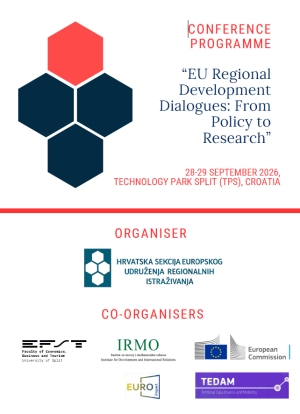
Conference titled “EU Regional Development Dialogues: From Policy to Research” will take place on 28–29 September 2026 in Split, Croatia (Technology Park Split) and is organised in cooperation with the Faculty of Economics, Business and Tourism, University of Split, the Institute for Development and International Relations (IRMO), and the Joint Research Centre of the European Commission, together with several institutional partners.
I would like to particularly highlight the second day of the conference, which will be dedicated to a Regional Science Research Incubator Workshop aimed at early-career researchers and PhD students. This workshop is designed as a mentoring and discussion platform where young researchers can present their research ideas or work in progress and receive detailed feedback from senior scholars and leading researchers in regional science. We believe this is a very valuable opportunity for young ERSA members to discuss their research at an early stage, improve their papers, and connect with senior researchers in the field.
More detailed information about the programme and the Research Incubator Workshop can be found here.
Tenure-Track Professor of Real Estate Development (Open Rank)
Tenure-Track Professor of Real Estate Development (Open Rank)
The University of Michigan Taubman College of Architecture and Urban Planning invites applications for a tenure-track faculty position at the rank of assistant professor, associate professor, or professor to develop field-defining research and teaching in real estate. The successful candidate will join a vibrant and collaborative community of faculty in the Urban and Regional Planning (URP) Program, home to our highly ranked Master of Urban and Regional Planning (MURP), the Ph.D. in Urban and Regional Planning, and the Bachelor of Science in Urban Technology. The successful candidate will play a central role in shaping a fast-growing real estate academic portfolio that includes a newly launched undergraduate minor in real estate and an established graduate certificate in real estate development. The portfolio is augmented by the Weiser Center for Real Estate, which hosts an active program of professional engagement and events.
Application Deadline: October 16, 2026
About Us
The Regional Science Association International (RSAI), founded in 1954, is an international community of scholars interested in the regional impacts of national or global processes of economic and social change.