
Regional Science Policy and Practice
Elisabete Martins
New Issue: Regional Science Policy & Practice | Volume 18, Issue 6, June 2026
|
|
Articles
|
|
|
|
|
|
Book Reviews
|
|
|
New elected RSAI Fellow for 2026
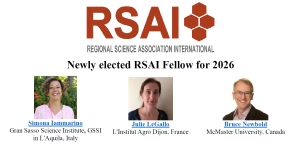
The RSAI President, Prof Shibusawa, and the RSAI Executive Director, Ana Vinuela, have the pleasure to announce the new elected RSAI Fellow for 2026.
But first, we would like to thank the members of the RSAI Fellows Selection Committee -made up of Prof. Jouke Van Dijk (Chair), Amit Batabyal and Sarah Low, who received and evaluated the candidatures for this year's RSAI Fellows election; and also thank all the RSAI Fellows that participated in the ballot.
According to the votes received from the RSAI Fellows, three (3) new Fellows have been elected this year, 2026 (ordered in alphabetical order):
- Simona Iammarino (Gran Sasso Science Institute, GSSI in L'Aquila, Italy)
- Julie Le Gallo (L'Institut Agro Dijon, France)
- Bruce Newbold (McMaster University, Canada)
Congratulations to all for this outstanding achievement!
NARSC Update
|


Winner of the 2026 RSPP Best Paper Award
The jury, made up of Alessandra Faggian (RSAI Fellow), Terciane Sabadini-Carvalho (RSPP Editor), Andrea Caragliu (RSPP EiC), Dan Rickman (RSAI Fellow), and Yoshiro Higano (RSAI Fellow), selected the following paper published by Regional Science, Policy & Practice as recipient of the 2026 RSPP best paper award:


 Teixeira, D. N., Santos, G. F., & Carmo, T. O. (2025). Gender gap and local economic diversity in microfinance: Evidence from the microcredit program in Brazil. Regional Science Policy & Practice, 17(9), 100217. https://doi.org/10.1016/j.rspp.2025.100217
The jury provided the following motivation:
The paper by Diego Teixeira, Gervásio Santos, and Tyago Carmo enters the literature tackling the financial aspects of the gender gap. With the application of sophisticated econometric techniques, including PSM, Instrumental Variables, and logistic regressions, the authors document the existence of a substantial and statistically significant gender gap in the CrediBahia program in the State of Bahia, Brazil. Their findings suggest a lower probability of default and higher chances of profits for women engaged in the microcredit program with respect to males. The paper perfectly fits the scope of the journal, and highlights the spatial aspects in the assessment of the impact of a local policy. Congratulations to the authors!
Congratulations to the prize winners on their achievement!
The New Issue of Regional Statistics is already Available! (2026, VOL 16, No 2)
REGIONAL STATISTICS, 2026, VOL 16, No 2.
STUDIES
Dear Readers,
We are pleased to say that the 2/2026 issue of Regional Statistics has been published and available online!
CONTENT
Meriem Benhachiche – Nassim Hallal – Mohammad Talebi: Integrating moment ratio and relative intensity methods for earthquake forecasting: a case study of the Zagros region
https://www.ksh.hu/statszemle_archive/regstat/2026/2026_02/rs160201.pdf
Ilia M. Chernenko – Irina I. Semenova: Adult learning and labour market outcomes: the moderating role of varieties of Russian state-led regional economies between 2013 and 2023
https://www.ksh.hu/statszemle_archive/regstat/2026/2026_02/rs160202.pdf
Tamás Szabó: Role of public services in maintaining the population of settlements
https://www.ksh.hu/statszemle_archive/regstat/2026/2026_02/rs160203.pdf
Ramil I. Hasanov – László Vasa – Ilhama Mahmudova – Muslum Mursalov – Jeyhun Hajiyev: Relationship between economic growth and income inequality: a comparative analysis of the United States and the United Kingdom
https://www.ksh.hu/statszemle_archive/regstat/2026/2026_02/rs160204.pdf
Levente Nádasi – Sándor Kovács – Gábor Petneházi – Zsuzsanna Trón: The analysis of stability in the EU convergence clubs by using Poincaré plot features
https://www.ksh.hu/statszemle_archive/regstat/2026/2026_02/rs160205.pdf
Balázs István Tóth: Mapping regional AI: application of neural network for classifying European regions based on AI technologies using enterprise-related data
https://www.ksh.hu/statszemle_archive/regstat/2026/2026_02/rs160206.pdf
Binh Thi Thanh Dang – Huyen Thi Thanh Do – Trung Xuan Hoang: Does free health insurance matter to the poor? New evidence from recent data in Vietnam
https://www.ksh.hu/statszemle_archive/regstat/2026/2026_02/rs160207.pdf
Tamás Csontos – Andrea Éltető – Magdolna Sass: Foreign direct investment and trade patterns in the European Union: implications for competitiveness
https://www.ksh.hu/statszemle_archive/regstat/2026/2026_02/rs160208.pdf
Join us to our social networking sites:
NARSC Update | Call for Papers North American Meetings of the Regional Science Association International Philadelphia, PA November 11-14, 2026

|


Extended the abstract deadline: Call for Papers: PRSCO 2026
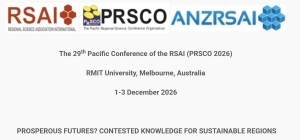
The deadline for abstract submission of PRSCO 2026 is extended to 14 May 2026 (the processing will still start 30 April 2026 to ensure initial decision to take place on 31 May 2026).
More detail;
https://www.anzrsai.org/conference/conference-2026/
------
The 29th Pacific Conference of the RSAI (PRSCO 2026) RMIT UNIVERSITY, MELBOURNE, AUSTRALIA 1-3 DECEMBER 2026
PROSPEROUS FUTURES? CONTESTED KNOWLEDGE FOR SUSTAINABLE REGIONS
FIRST CALL FOR PAPERS
Australia New Zealand Regional Science Association International (ANZRSAI) jointly with PRSCO is organising 29th PRSCO Conference at RMIT University, Melbourne. PRSCO welcomes proposals for contributed papers, for themed panels, or for special sessions, on any topic related to regions. This year’s conference is hosted by RMIT University, Melbourne. To register, and for more information on the conference, visit the ANZRSAI website at: https://www.anzrsai.org/conference/conference-2026/
The first call of papers can be downloaded (https://www.anzrsai.org/assets/Uploads/PRSCO-2026-First-Call-for-Papers-V1.pdf).
The deadline for abstract submission is 30 April 2026.
-----
Call for Submissions
PRSCO Award for Best Paper by a Young Regional Scientist
The Pacific Regional Science Conference Organization (PRSCO) offers a Best Paper Award annually. The Award is aimed at encouraging young regional scientists within the Asia-Pacific region to participate in research within the PRSCO community and to achieve research excellence. PRSCO now invites submissions for the 2026 Award.
The Award will be made for the best submission to the PRSCO Best Paper competition by a young regional scientist, under the age of 35 (on December 31, 2026), who is from a PRSCO-relevant part of the world.
The Award rules can be found on the PRSCO web site.
Papers submitted for the Best Paper Award should be presented to the 28th Pacific Conference of the RSAI in 2026 at Melbourne on December 1-3, 2026.
The LOC of the PRSCO 2026 will waive the registration fee for the Prize winner.
Eligible authors who wish to submit a paper to the PRSCO Best Paper competition should email a pdf copy of their paper to the PRSCO Executive Secretary, Soushi Suzuki, This email address is being protected from spambots. You need JavaScript enabled to view it., by no later than July 31, 2026
Papers will be assessed by a PRSCO Best Paper Selection Committee and the author of the winning paper is expected to be notified by October 31, 2026. The decision of the Selection Committee will be final.
Submissions should include a cover page with the paper’s title, the author’s full name, affiliation, and contact details. Award applicants should either: state that the paper is single-authored; or provide the name of the co-author(s), together with evidence that the applicant is the lead author and has contributed over 70 per cent of the paper’s content. The applicant should also affirm that they meet the Award’s age criterion.
New Issue: Regional Science Policy & Practice | Volume 18, Issue 5, May 2026
|
|
Articles
|
|
|
|
|
|
Book Reviews
|
|
Andrea Caragliu, winner of the Hirotada Kohno Award


Andrea Caragliu, winner of the Hirotada Kohno Award
The committee (made up of Prof. Hiroyuki Shibusawa, RSAI President, Chair; Prof. Budy Resosudarmo and Prof. Andrés Rodríguez-Pose, LRPC members; and Prof. Sarah Low, RSAI Council member) in charge of selecting the winner of the 2025 Hirotada Kohno Award have reached a consensus, after careful deliberation, in selecting Prof. Andrea Caragliu to be the recommended recipient.
The motivation provided by the committee reads as follows: Professor Andrea Caragliu has demonstrated long-standing and outstanding service to RSAI across multiple dimensions. He held the position of Executive Director for two terms (2020–2025), during which he played a central role in the management and strategic development of RSAI. He also contributed significantly to the successful organization of two RSAI World Congresses, held in Morocco and Hungary, which enhanced international collaboration.
Professor Andrea Caragliu further served as Editor-in-Chief of the RSAI journal Regional Science Policy & Practice, strengthening the academic foundation of Regional Science. He also served as co-editor of the RSAI Newsletter for six years, contributing to effective communication and community building. He also acted as editor of ERSA’s journal Global Challenges and Regional Science. Moreover, he has been an active member of the Italian section of RSAI (AIRSe), served one term as auditor of AISRe, and is currently a member of the AISRe Board. He also acts as EOC member of ERSA.
Through these contributions, Professor Andrea Caragliu clearly meets the criteria of long-standing and outstanding service to RSAI and to the broader Regional Science community.
New Issue: Papers in Regional Science | Volume 105, Issue 2, April 2026
Articles
Book reviews
|

About Us
The Regional Science Association International (RSAI), founded in 1954, is an international community of scholars interested in the regional impacts of national or global processes of economic and social change.